
We All Started Out as Children
Raise your hand if you started out life as a child. If you raised your hand, this book is for you.

That’s the simple truth at the heart of The Enneagram World of the Child. The Enneagram is often taught as a map of personality types, but before we became “types,” we were children—wide-open beings, adapting moment by moment to the world around us. To fully understand our Enneagram personality type, we need to look not only at the types themselves but also at the early conditions that shaped them.
Under the Hood of Personality
Most books on the Enneagram describe the nine types like categories—each with its strengths, challenges, and tendencies. But The Enneagram World of the Child goes under the hood. It examines the developmental forces at work during childhood that contribute to the formation of personality.
Rather than asking “Which type am I?” this book asks, “What experiences formed my type in the first place? What emotional currents shaped the person I believe myself to be?” When we see personality in this deeper light, we also begin to see the ways it can loosen, soften, and transform.

The Three Primal Forces
Every child encounters three primary emotions: anger, fear, and shame. These aren’t just passing moods—they are elemental forces that imprint themselves into our developing sense of self.
- Anger says, “This is me. This is mine.” It rises when the self feels intruded upon or denied its natural expression.
- Fear says, “I might not survive.” It emerges from the child’s absolute dependence and the uncertainty of the environment.
- Shame says, “There’s something wrong with me.” It takes hold when the child senses rejection or feels unworthy of love.
Together, they form the crucible in which personality is forged. How we adapt to, defend against, or disguise them becomes the foundation of our Enneagram type.
The Forces Driving Adaptation
Two other forces are always at work, shaping how the child adapts: the need to belong and the need to be seen.
- Belonging says, “I must be part of the circle, or I will not survive.”
- Being Seen says, “I need to be seen to exist.”
When these needs are only met conditionally—when belonging requires compliance or being seen depends on performance—the child learns to adapt. Personality becomes the mask we put on to secure belonging or to be seen in a way that feels acceptable.
The Liberating Forces
Thankfully, two other forces open the door to freedom. They are the liberating forces: acceptance and curiosity.
- Acceptance says, “Who you are is welcome here.” It loosens the demand to be someone other than who you are.
- Curiosity says, “What is this, really?” It opens the way to discovery, softening the grip of old strategies.
Together, they allow us to reconnect with what is essential, the part of us that never needed fixing or improving in the first place.

Not About Typing Children
A critical point: The Enneagram World of the Child is not about categorizing children by type. Children are too fluid, too alive in their becoming, to be pinned down as “a type.”
Instead, this book helps parents, teachers, and therapists recognize how their personalities influence a child’s development. It reveals how early dynamics shape the soul’s journey and offers ways to nurture resilience, openness, and trust in essential being.
And for individuals, it becomes a mirror: a way to revisit our childhood, to see how our type came into being, and to rediscover the possibilities that were left behind.
Why This Matters for You
Why should this matter if you’re no longer a child? Because the child you once were still lives within you. The echoes of anger, fear, and shame still shape your reactions today. The drive for belonging and being seen continues to influence your choices. And the liberating forces of acceptance and curiosity are still available—waiting to release you into a larger, freer life.
To explore the Enneagram without understanding its roots is to study the leaves of a tree without grasping its foundation. The Enneagram World of the Child invites you to dig deeper, to see not just what type you are but how that type came to be—and how the truth beneath it can reemerge.
So once again: raise your hand if you started out life as a child.
If you raised your hand, this book is for you. It’s not just about children. It’s about you. It’s about the hidden world beneath your personality, the forces that shaped it, and the freedom that comes when you see them clearly.
Because to understand the child is to understand yourself. And to understand yourself is to glimpse the possibility of being more than the self you think you are.
The Dance of Development
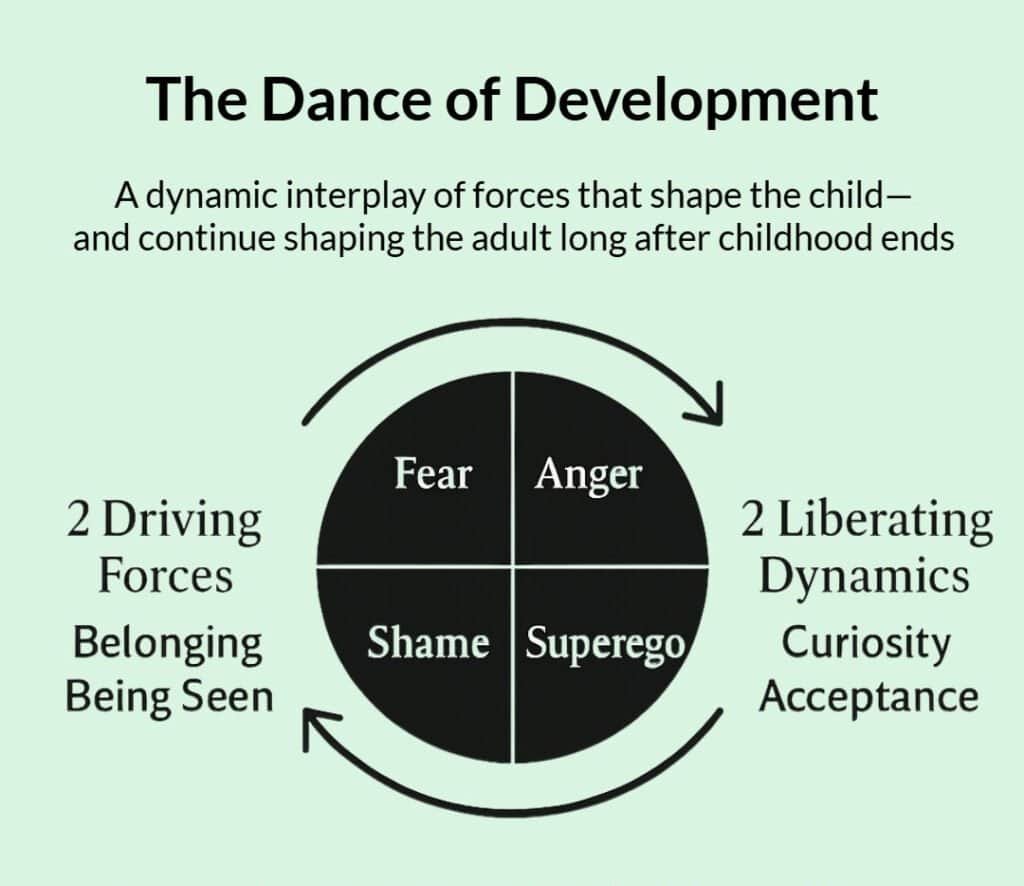
If this exploration stirs something in you, you may also be interested in ‘The Dance of Development’—a 7-week online course where we work directly with the primal forces that shape personality and the liberating forces that loosen their hold. Together we’ll explore fear, anger, shame, the superego, belonging, being seen, curiosity, and acceptance as living dynamics within our experience. If you’d like to be notified about future dates for this class, please email me and I’ll ensure you receive the details. EnneaChild@gmail,com
John Harper is a Diamond Approach® teacher, Enneagram guide, and a student of human development whose work bridges psychology, spirituality, and deep experiential inquiry. He is the author of The Enneagram World of the Child: Nurturing Resilience and Self-Compassion in Early Life and Good Vibrations: Primordial Sounds of Existence, available on Amazon.